
Choosing the right early education option is one of the biggest decisions parents make in their child’s early years. Many Sydney families wonder whether long day care or preschool is the better choice — especially when balancing work, learning goals and their child’s individual needs.
Understanding how each option works (and how both are regulated) will help you make a confident, informed decision.
First, the frameworks every quality service works within
In Australia, approved education and care services all operate under the same national system, so you can compare them fairly:
1. NQF (National Quality Framework) — the national system that sets the legal standards for early childhood services, administered by ACECQA and regulated in our state by the NSW Department of Education.
2. NQS (National Quality Standard) — the benchmark every service is assessed and rated against, across 7 quality areas (from educational program to health & safety, staffing and leadership).
3. EYLF (Early Years Learning Framework — Belonging, Being & Becoming) — the approved learning framework that guides how educators plan play-based learning for children from birth to five.Both long day care and quality preschool programs follow the EYLF — the difference is mostly in hours, ages and how the day is structured.
Understanding long day care
Long day care (LDC) provides education and care for children from infancy through to school age, and operates for extended hours to support working families. Quality LDC is far more than minding children — it delivers a structured, EYLF-based educational program alongside nurturing daily care, supporting children socially, emotionally, physically and cognitively through play. Typical experiences include creative arts, sensory play, storytelling and early literacy, outdoor exploration, music and movement, and everyday social interaction with peers.
Because LDC is an approved service under the NQF, it works to regulated educator-to-child ratios under the Education and Care Services National Regulations — for example, 1 educator to 4 children for babies (birth–24 months), 1:5 for toddlers (24–36 months), and 1:10 for children 36 months to preschool age — as well as qualification requirements for educators.
What is preschool?
Preschool is designed mainly for children aged 3 to 5 and focuses on the year or two before primary school. Programs usually run during school hours and school terms, and may not offer full-day, year-round care.
Preschool places a strong emphasis on school readiness — early literacy and numeracy, problem-solving, emotional regulation, group participation and classroom routines — still delivered through play.
In NSW, families can benefit from two funding streams:
The Australian Government’s Child Care Subsidy (CCS) for approved services, and the NSW Government’s Start Strong fee relief for children in the year(s) before school. Importantly, Start Strong is available through both community preschools and long day care services (Start Strong for Long Day Care) — so eligible 3–5 year olds can access it whichever setting you choose, and at an approved long day care like ours, families can receive both CCS and Start Strong.
A quick NSW clarification: in New South Wales, “Kindergarten” means the first year of primary school (around age 5) — not the preschool year, as it does in Victoria and Queensland. So the order here is: long day care or preschool (ages 3–5) → Kindergarten (first year of school) → Year 1. Always check the age range and hours, not just the name on the sign.
Long day care vs preschool vs kindergarten — at a glance
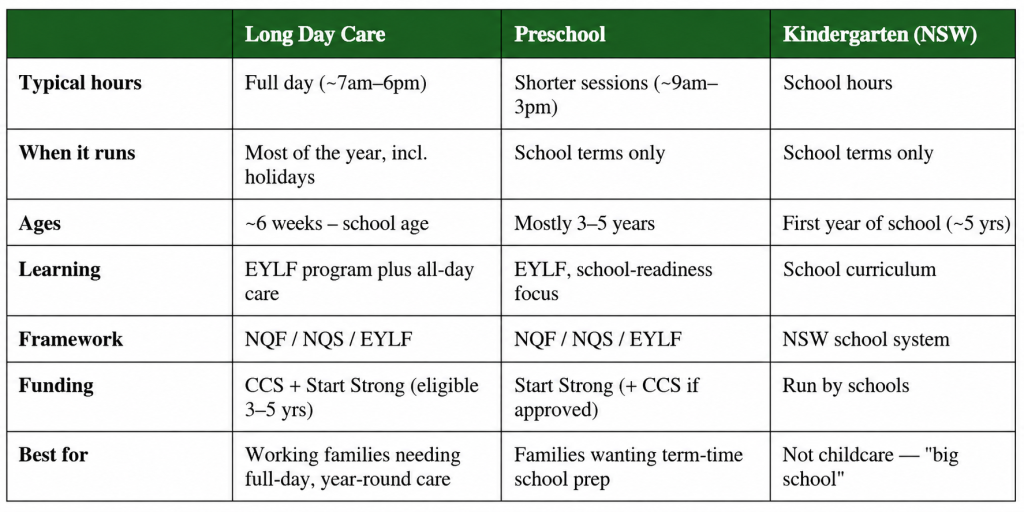
Which option is better for your child?
- It depends on your family’s circumstances and your child’s developmental needs. Long day care may suit you if you:
- Need full-day care while working;
- Want consistent routines throughout the year;
- Have younger children needing ongoing care; or
- Prefer one continuous learning journey from infancy to school age.
Preschool may suit you if you:
- Only need part-day education;
- Have a flexible family schedule; or
- Want a dedicated school-readiness program in the year before Kindergarten.
Many parents are pleasantly surprised to learn that a quality long day care centre delivers a preschool program within full-day hours — so you get the educational benefits traditionally linked to preschool and the flexibility of all-day, year-round care, without piecing together separate before- and after-care.
Why play-based learning matters
The EYLF is built on the understanding that young children learn best through meaningful, guided play rather than formal instruction alone. Through play, children naturally build language, creativity, critical thinking, fine and gross motor coordination, social confidence and emotional resilience. Skilled educators observe each child’s interests and intentionally plan experiences that extend their learning toward the EYLF’s five Learning Outcomes — a child’s sense of identity, connection to their world, wellbeing, confidence as a learner, and communication.
How Kradle 2 Krayons supports every child
At Kradle 2 Krayons Pendle Hill, children experience a balanced program that combines nurturing care with engaging, EYLF-based learning. Our experienced educators create safe, welcoming environments where every child feels confident to explore, learn and grow. Our program focuses on individual learning journeys, school readiness, social and emotional development, creative exploration, outdoor learning and strong family partnerships.
Proudly rated Exceeding the National Quality Standard
Kradle 2 Krayons Pendle Hill is rated Exceeding the National Quality Standard — one of the highest ratings a service can achieve under the NQF, and one held by only around 1 in 5 services nationally. In practice it means our practice goes above and beyond the standard: it’s embedded in everyday routines, shaped by ongoing critical reflection, and built around each child, family and our Pendle Hill community.
Tips for choosing the right early learning service
- When you visit a service, it’s worth asking:
- What is the service’s current National Quality Standard rating? (You can also look this up on the national registers or Starting Blocks.)
- Are educators qualified and experienced, and what are the educator-to-child ratios?
- How is learning planned for each child under the EYLF?
- How are families involved, and how is communication with parents managed?
- What daily routines are followed, and are the indoor and outdoor spaces engaging and safe?
Taking a tour lets you experience the environment first-hand and decide whether it feels like the right fit.
Final thoughts
Both long day care and preschool offer valuable, EYLF-guided learning that supports your child’s development. The best choice depends on your family’s schedule, your child’s personality and the experience you’re seeking. For many families across Sydney and Pendle Hill, a centre that combines quality care with a structured preschool program delivers the best of both — the flexibility of long day care alongside genuine school-readiness, in one consistent, nurturing environment.
Frequently asked questions
1. What is the difference between long day care and preschool?
Long day care provides extended, year‑round care with an EYLF‑based educational program, while preschool mainly focuses on school readiness through shorter, term‑time sessions. Both are regulated under the NQF and follow the EYLF.
2. Is “kindergarten” the same as preschool in NSW?
No. In NSW, Kindergarten is the first year of primary school (around age 5), run by schools. The pre‑school‑age program for 3–5 year olds is called “preschool” here.
3. Does long day care prepare children for school?
Yes. Quality long day care follows the EYLF and embeds school‑readiness — literacy, numeracy, communication and social skills — into everyday play, supporting a smooth transition to Kindergarten.
4. What do the EYLF, NQF and NQS actually mean for my child?
The NQF is the national law and system for early childhood services; the NQS is the quality benchmark services are rated against across seven areas; and the EYLF is the learning framework educators use to plan play‑based learning. Together they mean your child’s service is held to consistent, high national standards.
5. What does an “Exceeding” rating mean?
Exceeding the National Quality Standard” is one of the highest ratings a service can receive — awarded when a service goes beyond the standard in a way that’s embedded, reflective and shaped by families and community. Only about 1 in 5 services nationally hold it, and Kradle 2 Krayons Pendle Hill is proudly one of them.
6. Why choose Kradle 2 Krayons?
Nurturing, qualified educators; play‑based, EYLF‑guided learning; personalised programs; strong family partnerships; and an Exceeding‑rated environment that helps children become confident, capable learners ready for their next step.
See our Exceeding‑rated program for yourself
Book a friendly, no‑pressure tour of Kradle 2 Krayons Pendle Hill and meet our educators.
This article is general information only. Framework references (EYLF, NQF, NQS) reflect the National Quality Framework administered by ACECQA and regulated in NSW by the NSW Department of Education. Ratios and funding (Child Care Subsidy, Start Strong) are current at time of writing — please confirm your own eligibility with Services Australia and Service NSW. Kradle 2 Krayons Pendle Hill.