
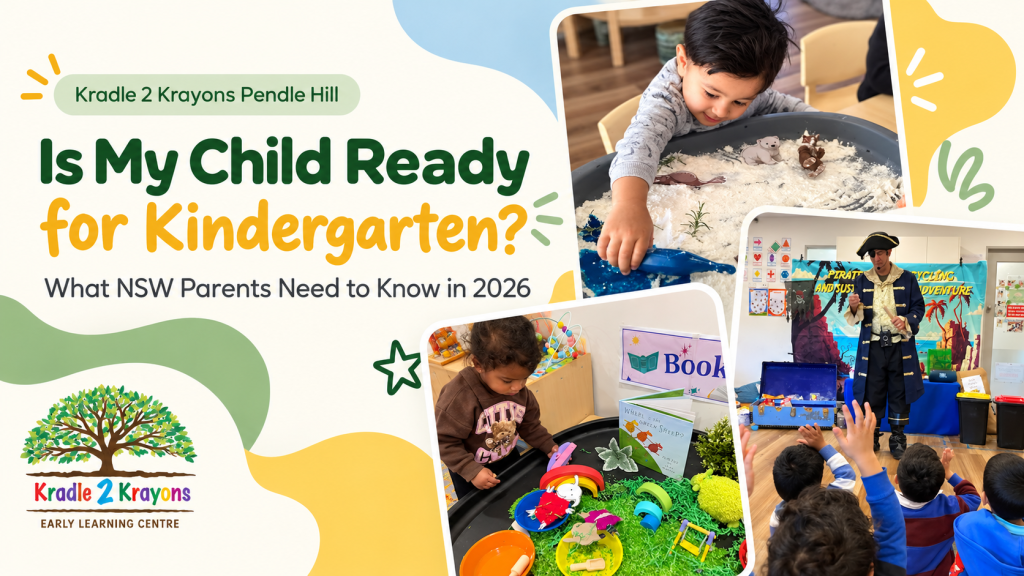
Every October, the same question quietly surfaces in households across Western Sydney.
Is my child ready for kindergarten?
It’s one of the most searched questions NSW parents type into Google — and for good reason. Kindergarten in NSW starts in January 2027 for children turning five on or before 31 July 2027. If your child is in that window, the decisions you make in the next few months matter more than most parents realise.
Here’s what school readiness actually means, what it doesn’t mean, and how quality long day care in Pendle hill plays a direct role in setting children up for their best possible start.
What School Readiness Actually Means
Let’s clear something up first.
School readiness is not about whether your child can write their name, count to 20, or recite the alphabet. Those skills matter — but they’re not what determines how well a child transitions into kindergarten.
The research is clear. Children who thrive in their first year of school are those who can:
- Manage their emotions — handle frustration, transitions, and disappointment without falling apart
- Follow simple instructions — listen, focus, and act on what they’ve heard
- Communicate their needs — use words to ask for help, express feelings, and connect with others
- Take turns and share — the social scaffolding that group learning depends on
- Attempt tasks independently — try something new without needing constant adult reassurance
None of these are academic skills. They’re social and emotional skills — and they are built through years of quality early childhood experience, not weeks of flashcard drilling before January.
A child who walks into kindergarten with strong emotional regulation and confident communication will outperform a child who can spell their name but struggles to sit in a group, every time.
The 5 Things That Actually Predict Kindergarten Success
1. Strong Sense of Self
Children who know who they are — what they like, what they’re good at, how they feel — transition into new environments with greater confidence. This is why the Early Years Learning Framework (EYLF) puts identity as the very first of its five learning outcomes.
At Kradle 2 Krayons, building a child’s sense of self is woven through everything — how educators greet children each morning, how they narrate each child’s strengths back to them, how they create space for children to make real choices throughout the day.
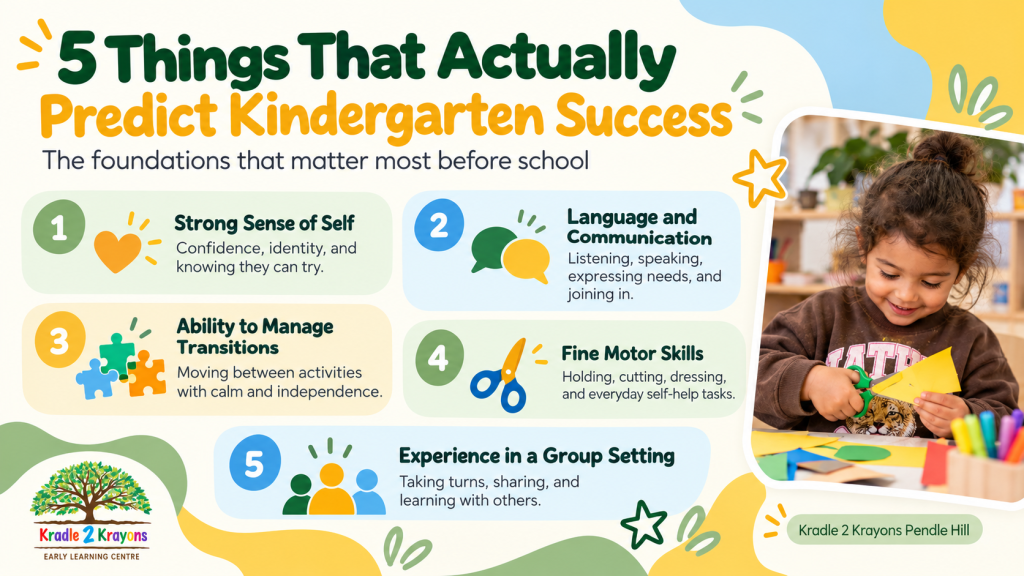
2. Language and Communication
Children with strong vocabulary and communication skills engage more readily with teachers, make friends faster, and access learning content more easily from day one.
Rich language isn’t about correcting grammar. It’s about an environment where children hear and use a wide range of words every single day — through storytelling, conversation, questions, books, songs, and everyday experiences. At K2K, our educators are trained in deliberate language practice across every age group, from infants through to preschoolers.
One of the ways we build confidence alongside language is through our Show and Tell programme — where children share something meaningful from their world with the group. This simple practice builds vocabulary, listening skills, social interaction, and the kind of confident spoken communication that children need from their very first day of school.
3. Ability to Manage Transitions
The kindergarten day is full of transitions. From the mat to the desk. From lunch to reading time. From inside to outside. Children who have practised moving between activities — calmly and with reasonable independence — are far better equipped than those for whom every transition has been managed entirely by an adult.
Predictable routines with clear, narrated transitions are a daily feature of our Pendle Hill programme. Not because we like structure for its own sake, but because we know what children need when they walk through a school gate for the first time.
4. Fine Motor Skills
Holding a pencil, cutting with scissors, managing buttons and zips, eating independently — fine motor development is one of the most practical predictors of early school confidence. Children who struggle with these skills can find the physical demands of the classroom exhausting, before they’ve even started on the learning content.
Our programme at K2K includes daily art and creative activities, cooking experiences, STEM investigations with tools and materials, and outdoor physical play — all of which build fine motor strength and coordination progressively through the preschool years.
We also place a strong emphasis on self-help skills — actively supporting children to build independence through everyday tasks such as dressing, toileting, eating, packing their own belongings, and managing personal routines. These are the practical skills that make the kindergarten day feel manageable rather than overwhelming.
5. Experience in a Group Setting
Children who have spent time in a quality early learning environment before starting school arrive already knowing how to be part of a group — how to wait, how to contribute, how to navigate disagreement. This social competence is something that simply cannot be fast-tracked at home, however wonderful that home is.
This is arguably the single strongest argument for quality long day care or preschool attendance in the years before kindergarten.
What NSW Kindergarten Entry Actually Requires
In NSW, children must start kindergarten in the year they turn five, provided their birthday falls on or before 31 July 2027 for the 2027 school year.
There are no academic tests or entry assessments. There is no “passing” kindergarten readiness. Every child who meets the age requirement is entitled to enrol.
What this means is that the preparation is entirely up to families and their early learning providers — which is why the quality of the childcare or preschool environment your child attends in the years before school is so significant.
How K2K Pendle Hill’s School Readiness Programme Works
At Kradle 2 Krayons, school readiness isn’t a separate programme that switches on in the preschool year. It’s a progression that begins the day your child walks in.
For infants and toddlers, the foundation is laid through:
- Consistent, responsive relationships with educators
- Rich language environments from the earliest weeks
- Sensory exploration and physical play that builds neural pathways
For preschool-age children (3–5 years), our deliberate school readiness programme includes:
- Phonological awareness — hearing and playing with sounds in words, which is the strongest single predictor of reading success
- Numeracy foundations — counting, pattern recognition, spatial reasoning through hands-on play
- Show and Tell — children share something meaningful or interesting from their world, building confidence, communication, vocabulary, listening skills, and social interaction in a structured group setting
- Self-help skills — supporting children to build independence through everyday tasks such as dressing, toileting, eating, packing belongings, and managing personal routines
- ELSA and ELLA programmes — play-based digital learning programmes that support children’s early STEM thinking and language development through engaging, age-appropriate activities
- Primary school excursions — opportunities for children to explore new environments and real-world experiences, supporting confidence, learning, and connection with the wider community
- Primary school staff incursions — visits from local primary school staff to help children become familiar with school expectations, routines, and what the transition to kindergarten actually looks like
- Group project work — collaborative learning that mirrors the kindergarten classroom environment
- Self-regulation strategies — simple breathing, body awareness, and emotional vocabulary tools
All of this is guided by the EYLF and delivered by qualified early childhood educators — not a scripted checklist, but a responsive, child-led programme that meets each child where they are.
When Should You Talk to Your Centre About the Kindy Transition?
Now. October is exactly the right time.
If your child is heading to kindergarten in January 2027, the conversations to have with your K2K educators this term include:
- What specific areas of development is my child strong in?
- What are they still working on?
- What can I do at home to support their transition?
- What does the transition to kindy process look like from the centre’s side?
Quality early childhood services in NSW are expected, under the National Quality Standard, to actively support children’s transitions to school — including communication between educators and receiving schools, transition statements, and collaborative planning with families.
We take that responsibility seriously. Your child’s transition is not a hand-off. It’s a supported journey.
What Parents Can Do at Home Right Now
The best thing you can do this October is not drill letters and numbers. It’s this:
Talk to your child constantly. Rich conversation is the single most effective home-based input for school readiness. Ask open questions. Name emotions. Tell stories. Read every day — not as homework, but as a shared pleasure.
Let them struggle productively. Resist the urge to do things for them. Let them pour their own water, pack their own bag, choose their own outfit. Independence built now pays dividends in January.
Practise routines. Early starts, getting dressed independently, eating breakfast quickly, having everything ready the night before. Kindergarten is wonderfully consistent in its rhythms — children who have practised predictable routines settle in faster.
Talk about school positively and honestly. Children pick up on parental anxiety. “You’re going to love it” is more useful than “it’ll be fine, don’t worry” — the second signals that there’s something to worry about.
Places for 2027 Are Already Being Secured
If your child is heading to school in January 2027, this is also a natural moment to think about your after-school care arrangements — and whether any siblings at home will need a childcare place in the new year.
At K2K Pendle Hill, we care for children from 6 weeks to 5 years, and places for early 2027 are moving. If you have a younger child at home, or if you’re returning to work and need a place secured, October is the right time to enquire.
Book a tour and see our preschool room in action.
FAQs
1. When does kindergarten start in NSW in 2027?
Children start kindergarten in NSW in the year they turn five. For the 2027 school year, children must have their fifth birthday on or before 31 July 2027. The first day of school is typically late January 2027.
2. What does school readiness actually mean?
School readiness refers to a child’s social, emotional, communication, and physical development — not academic knowledge. Key indicators include the ability to manage emotions, follow instructions, communicate needs, take turns, and attempt tasks independently.
3. Does my child need to know how to read before starting kindergarten in NSW?
No. There are no academic entry requirements for kindergarten in NSW. Children are not expected to read, write, or do formal maths before starting school. What matters far more is social and emotional development.
4. What is the EYLF and how does it prepare children for school?
The Early Years Learning Framework (EYLF) is Australia’s national curriculum for children from birth to five. It guides how approved childcare centres plan learning across five outcomes — identity, community, wellbeing, learning, and communication — all of which directly support the transition to formal schooling.
5. What age groups does Kradle 2 Krayons cater for?
We care for children from 6 weeks to 5 years across infant, toddler, and preschool rooms. Our school readiness programme is embedded in the preschool room for children aged 3–5.
6. How does K2K Pendle Hill support the transition to kindergarten?
We offer individual transition conversations with families, EYLF-aligned transition statements, Show and Tell, ELSA and ELLA programmes, primary school excursions, primary school staff incursions, and a preschool programme that builds phonological awareness, numeracy foundations, self-help skills, emotional regulation, and independence.
7. Is there an enrolment fee at K2K?
No. There is no enrolment fee and no bond. All meals, snacks, nappies, and the full extracurricular programme are included in the daily fee.
8. How do I book a tour at Kradle 2 Krayons Pendle Hill?
Visit kradle2krayons.com.au/booking or call 02 4721 7607. Tours are free and take place during a live session so you can see the rooms as they really are.